
Urban Concrete & Construction
Upgrade To A Reinforced Concrete Driveway Without Worrying About Blackland Prairie Soil Destroying Your Investment..
We engineer permanent concrete driveways using a compacted crushed rock base and #3 steel rebar to easily support the weight of modern SUVs.
Heavy-Duty Structural Concrete Driveway Replacements
When your driveway fractures under heavy vehicle loads or shifts due to expansive clay, cosmetic patching will not save it. We perform complete flatwork tear-outs and install heavy-duty structural concrete driveways in Dallas. We prioritize deep subgrade compaction and steel grid reinforcement to permanently restore load-bearing capacity.
Driveways are the hardest working exterior surface on any residential property. Every time a 6,000-pound vehicle rolls over the threshold, immense kinetic energy transfers directly into the concrete matrix. If the subgrade preparation is inadequate or the concrete lacks proper steel reinforcement, that energy has nowhere to dissipate, causing the slab to shear and crack under the pressure. Our structural replacement process eliminates the root cause of this failure. We absolutely do not pour fresh concrete over compromised dirt. We extract the ruined material, re-engineer the soil profile, and pour a high-density, commercial-grade mix that distributes vehicle weight evenly across the surface. This is not a cosmetic band-aid; it is a permanent geotechnical upgrade for your property. By focusing on the foundation beneath the flatwork, we guarantee a driveway that stays perfectly level and crack-free through the harshest Texas weather cycles. We refuse to compromise on the structural integrity of your home’s primary access point.

Tearing Out a Structurally Shattered Driveway in East Dallas
Recently, we received a call from a homeowner in East Dallas whose original, forty-year-old driveway had degraded into a treacherous obstacle course. Decades of extreme soil movement and heavy vehicle traffic had shattered the thin concrete into dozens of jagged, uneven pieces. The homeowner was driving a heavy modern SUV, and the constant, violent bouncing over the broken slab was actively destroying the vehicle’s suspension system. They were terrified to let their children play basketball in the front yard due to the massive, sharp trip hazards.
Excavating Decades of Subgrade Failure
When our demolition crew arrived, we discovered exactly why the original flatwork failed so spectacularly. The previous contractor had simply dumped three inches of cheap concrete directly on top of the native clay without laying a proper rock base or installing a single piece of steel reinforcement. We brought in our skid steers equipped with hydraulic breakers and systematically demolished the ruined slab. We then excavated eight inches of the saturated, failing mud base. We hauled away the compromised dirt and installed a thick, compacted layer of TxDOT-approved crushed rock. Once the subgrade was locked in place, we tied a tight grid of heavy steel rebar and poured a 6-inch, 4,000 PSI concrete slab. The homeowner’s property was transformed from a suspension-destroying liability into a perfectly smooth, highly functional architectural asset that safely supported their heaviest vehicles without a single millimeter of deflection.


Why "We Do It All" Contractors Guarantee Immediate Concrete Failure
The local residential construction market is saturated with cheap, “we do it all” general contractors who treat concrete pouring as a side hustle rather than an exact science. Their standard operating procedure for a driveway replacement is to tear out the old concrete, rake the exposed dirt flat, and immediately pour the new cement directly onto the native clay. This lazy, cost-cutting tactic guarantees immediate, catastrophic failure. As we’ve established, Dallas clay soil shifts violently when wet. If you pour a rigid concrete slab directly onto a surface that moves, the concrete will inevitably break the very first time a heavy rainstorm hits. Those discount contractors skip the most critical step in the entire process: subgrade preparation. By refusing to dig out the expansive clay and refusing to haul in structural crushed rock, they save themselves a few hundred dollars on materials while costing you thousands of dollars in future repairs. When you hire a specialized flatwork contractor, you are paying for the invisible engineering beneath the surface. We refuse to pour on native clay. We build an unyielding, compacted aggregate foundation that acts as a shock absorber between the volatile soil and your expensive new driveway, ensuring the concrete matrix remains fully supported and intact, regardless of how much the native soil shifts.

Mandating Heavy-Duty Steel Reinforcement in Every Pour
Concrete possesses immense compressive strength, meaning it can hold a massive amount of weight pushing straight down. However, it lacks tensile strength, meaning it breaks easily when pulled or bent by the shifting earth below. To compensate for this weakness, steel reinforcement must be embedded directly into the slab. Unfortunately, many contractors try to save money by using cheap, rolled wire mesh. Wire mesh is incredibly flimsy, easily trampled to the bottom of the mud during the pour, and rusts away to nothing within a few years, offering zero actual support.
The Absolute Necessity of #3 Steel Rebar
We completely ban the use of wire mesh on our structural driveway replacements. Instead, we mandate the use of #3 deformed steel rebar on every single flatwork project we undertake. We tie this half-inch-thick steel into a continuous, rigid grid spaced at 18-inch centers. We place the grid on specialized plastic chairs to ensure the steel remains suspended perfectly in the center of the concrete slab during the pour. The deformations, or ridges, on the rebar physically lock into the curing concrete, giving the slab the immense tensile strength required to resist the bending forces of Texas soil heave and the heavy point-loads of modern vehicles. This rigorous steel engineering is the exact difference between a driveway that lasts five years and one that lasts fifty years.
Reversing the Slope Even If Your Driveway Funnels Water Into Your Garage
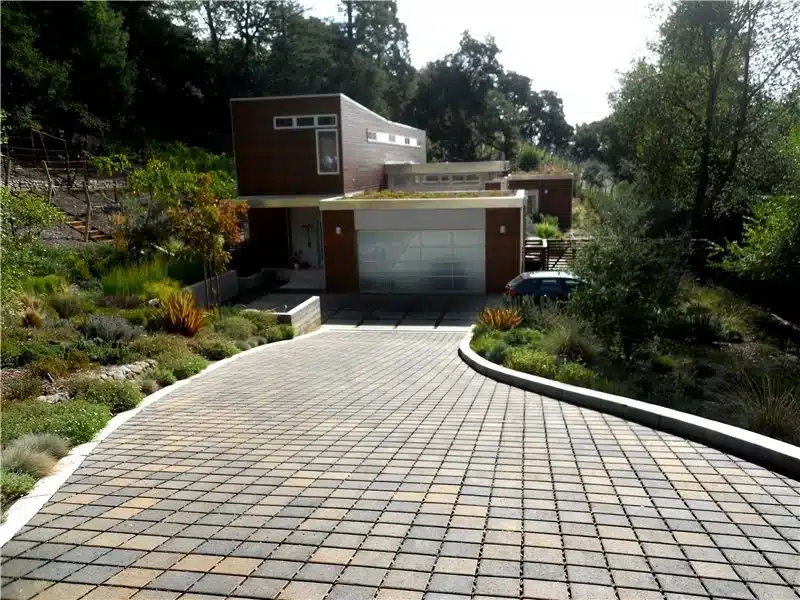
A common objection we hear from frustrated homeowners is the fear that their property’s elevation is simply unfixable. You might have a house that sits lower than the street, and for years, your sunken, incorrectly pitched driveway has acted like a massive water slide, funneling thousands of gallons of stormwater straight down into your garage or against your front door during every heavy downpour. You are terrified that a new driveway will just be a newer, cleaner water slide. We can completely resolve your drainage issues, even if your current slab is actively flooding your home. Before we set a single wooden form, our technicians deploy highly calibrated digital laser levels to map the exact topography of your front yard. We physically alter the grade of the earth during the excavation phase, cutting down the high spots and building up the low spots with compacted rock. We manipulate the geometry of the new slab, implementing precise cross-slopes and subtle crowns to ensure that gravity pulls every drop of rainwater away from your foundation and safely out toward the municipal street gutters or side-yard swales. We eliminate the standing water that threatens your foundation, turning a massive liability into a highly functional drainage asset.
Our 3-Step Structural Driveway Replacement Process
Replacing a major piece of structural flatwork requires heavy machinery, precise logistics, and strict adherence to chemical timelines. We execute a rigorous, three-step customer journey to minimize the disruption to your daily routine while maximizing the strength of the pour.

Step One is Total Flatwork Demolition.
We dispatch our skid steers to break up existing concrete, carefully extract heavy debris, and haul it away in commercial dump trailers to keep your street clean.

Step Two is Structural Subgrade Compaction.
We excavate the compromised clay, lay down our crushed rock base, and utilize heavy vibratory plate compactors to lock the aggregate into a dense, unyielding foundation before tying the steel rebar grid.

Managing the Concrete Curing Window
Step Three is the High-Strength Pour and Joint Cutting. We pour our 4,000 PSI concrete mix, screed it perfectly level, and apply a specialized broom finish for maximum tire traction. The timing of the final cuts is absolutely critical. Within 24 hours of the pour, we return with diamond-blade saws to cut deep control joints into the slab. These precise cuts dictate exactly where the concrete will naturally expand and contract during extreme temperature swings, preventing random, jagged cracks from ruining the surface of your newly cured driveway. This meticulous timing and execution guarantee a flawless finish that resists scaling, spalling, and uncontrolled fracturing for decades to come.
Protecting Your Home From Catastrophic Hydrostatic Pressure
The number one fear property owners have when altering the exterior of their home is unintentionally causing water damage to their primary foundation. A poorly-poured driveway is one of the most common causes of structural failure in residential houses. If a contractor pours a massive concrete slab right up against your brick veneer but fails to grade the slope correctly, rainwater will pool directly against your perimeter grade beams.

Establishing Positive Drainage Away from the Foundation
Because Dallas sits on highly absorbent clay, the pooling water quickly saturates the soil beneath your house, creating immense hydrostatic pressure. This pressure will eventually crack your foundation, warp your door frames, and cause thousands of dollars in damage to your interior drywall. We treat drainage as a matter of life and death for your home. We meticulously shoot laser grades to establish absolute positive drainage. We guarantee that the new concrete pitches downward, away from the foundation, at a minimum drop of one-quarter inch per foot. We install protective expansion joint material where the driveway meets the garage floor, sealing the gap to prevent water from seeping into the critical load-bearing soil beneath your home. By engineering perfect water diversion, we safeguard the structural integrity of your entire property.
Adapting Flatwork Design for 1960s Ranches vs. Modern Subdivisions
The architectural layout of your property dictates the engineering requirements of the driveway. Our replacement strategies are highly adaptable to the specific era of your Dallas home. If we are working on a classic 1960s ranch-style home in East Dallas or Richardson, we are frequently dealing with narrow, single-car driveways known as “ribbon drives” that run tightly between the house and a mature fence line. Homeowners often request that we widen these outdated approaches to accommodate two modern vehicles. This requires careful excavation alongside the existing foundation and strategic root pruning to expand the footprint safely without harming the home. Conversely, when we are hired to replace the flatwork in a modern North Dallas or Frisco subdivision, we are usually dealing with massive, three-car-spanning concrete aprons. Pouring a continuous slab of that magnitude requires advanced logistics. We must implement highly strategic joint layouts and utilize specialized expansion materials against the garage foundation and the street curb. This prevents the massive concrete volume from buckling against the rigid structures during the intense thermal expansion of the Texas summer. We engineer the specific layout to match your property’s unique scale, ensuring structural longevity regardless of the driveway’s overall footprint.
The Financial Disaster of Half-Inch Cementitious Overlays
When a driveway becomes severely cracked and stained, property owners are frequently tempted by the promise of a cheap, easy fix. A massive scam in the local industry is the “driveway resurfacing” pitch, where a contractor offers to pour a thin, half-inch layer of cementitious overlay directly on top of your shattered, sinking concrete to make it look brand new for a fraction of the cost. This is an absolute waste of your money. A thin cosmetic overlay possesses zero structural strength. If the concrete underneath is sinking because the soil has failed, the overlay will immediately sink with it. Furthermore, because of a phenomenon known as “reflective cracking,” every single jagged crack in the old slab will quickly mirror straight through the new surface. Within a few months of daily tire friction, steering wheel turns, and heavy rain, that cheap half-inch overlay will completely delaminate, flaking off in massive chunks and leaving your driveway looking far worse than when you started. Do not mask a structural failure with a cosmetic band-aid. The only permanent solution for a shattered slab is total demolition and structural replacement, addressing the failure at the subgrade level where the real problem exists.
Meeting Strict Dallas Public Works Standards for Flatwork Slopes
While your driveway sits on your private property, the point where it intersects with the municipal street and the public sidewalk is heavily regulated by the city. We do not guess at the engineering requirements; we execute every driveway replacement in strict adherence to the City of Dallas Public Works paving design manual. The city code dictates maximum allowable slopes to prevent vehicles from bottoming out and to ensure safe pedestrian passage across the right-of-way. For example, municipal regulations strictly govern the transition angle where your private flatwork meets the city approach.
If a contractor pours a driveway that is too steep or creates a tripping hazard across the public sidewalk easement, Dallas Code Compliance can force you to tear out the brand-new concrete at your own expense. We eliminate this bureaucratic risk entirely. We verify all transition slopes, ensure the curb tie-ins are flawlessly executed, and guarantee that your new structural driveway meets or exceeds all local residential building codes, protecting you from costly municipal fines and forced re-dos. We handle the technical compliance so you can enjoy your new driveway with absolute peace of mind.


Escaping the Jarring Bounce of a Sunken Concrete Slab
Living with a failing driveway is a daily, visceral annoyance that degrades your quality of life. You know the exact feeling: the heavy, jarring bounce that shakes your entire vehicle every single time you back out of the garage. It is the terrifying, metallic scrape of your undercarriage hitting a sunken transition joint, making you wince as you calculate potential repair bills. You constantly warn visitors to “watch their step” because the concrete panels have heaved in opposite directions, creating a minefield of sharp trip hazards right outside your front door. You shouldn’t have to navigate an obstacle course just to park your car. Upgrading to a structural concrete replacement completely changes this sensory experience. Instead of bracing for impact, you experience the absolute luxury of gliding silently and smoothly from the street directly into your garage. There are no sudden drops, no scraping bumpers, and no anxious warnings to guests. We restore the solid, immovable feeling of a perfectly engineered surface, transforming a daily frustration into a seamless, high-end entry point for your property that significantly enhances your daily driving experience and protects your vehicle’s expensive suspension components from unnecessary damage.

Executing Heavy Demolition Without Trashing Your Property
Tearing out thirty tons of steel-reinforced concrete requires violent, heavy machinery. Understandably, homeowners are terrified that bringing skid steers and hydraulic breakers into their front yard will result in shattered windows, ruined garage doors, and a destroyed lawn. We believe that protecting your existing property is just as critical as pouring the new slab. We enforce a military-grade cleanliness and logistics protocol on every demolition site.
Protecting Your Home’s Exterior Architecture
Before a single hammer strikes the concrete, we deploy protective measures. We lean heavy-duty plywood barriers against your expensive garage doors and wrap your lower brick veneer in protective plastic to shield it from high-velocity concrete shrapnel and flying gravel. We lay interlocking composite mats across your lawn if our machines need to traverse it, preventing deep tire ruts and broken sprinkler heads. When pouring fresh concrete, we use splash guards to ensure there are no wet cement stains on your home’s exterior. At the end of the project, we thoroughly power-wash the street and the surrounding areas. We leave your new driveway looking immaculate, and your home’s architecture completely untouched. We believe that professional construction should solve your problems, not create a massive, messy headache for your family to clean up afterward.

Your Trusted Dallas Authority for Structural Concrete Driveways
Your driveway is a critical piece of load-bearing infrastructure that protects your vehicles, manages massive amounts of stormwater, and serves as the visual centerpiece of your home’s exterior. When expansive Dallas clay and heavy vehicle loads shatter your flatwork, you cannot afford to rely on cheap cosmetic overlays or contractors who refuse to compact the subgrade. Urban Concrete & Construction is the premier technical authority in the metroplex for heavy-duty structural driveway replacements. We combine deep subgrade excavation, crushed rock bases, and strict #3 steel rebar reinforcement to pour 4,000 PSI slabs that permanently defeat the shifting Texas soil. Dispatched from our central McCallum Blvd hub, we understand the local building codes, we master the physics of positive drainage, and we respect your property from demolition to the final saw cut. Do not settle for another cracked, sinking slab. Invest in permanent geotechnical stability. Contact our Dallas dispatch team now to schedule a comprehensive flatwork assessment, and let us build a structural concrete driveway that will easily outlast the elements. We provide upfront, transparent quotes based on exact square footage, ensuring you get the ultimate structural upgrade without any hidden financial surprises.
Frequently Asked Questions About Concrete Driveway Replacement
How much does a structural concrete driveway replacement cost in Dallas?
The average cost is $8 to $15 per square foot for a complete structural driveway replacement. In the Dallas Metroplex, the final price is determined by the required depth of the TxDOT-approved crushed rock subbase and the linear footage of #3 deformed steel rebar. Urban Concrete & Construction provides flat-rate estimates that include heavy demolition, haul-away fees, and the 4,000 PSI concrete pour, eliminating hourly labor surprises.
Will Texas homeowners' insurance cover replacing a driveway that floods my garage?
No, standard Texas homeowners’ insurance policies do not cover replacement of a driveway caused by poor grading, soil subsidence, or normal wear and tear. Insurance adjusters classify negative drainage and the resulting hydrostatic pressure against your perimeter grade beams as a preventable maintenance issue. Urban Concrete & Construction protects your home by using laser-level grading to establish a positive slope of one-quarter inch per foot, permanently directing storm runoff into the municipal gutters.
How long does it take to tear out and replace a concrete driveway in Dallas?
It takes 3 to 4 days to completely demolish and replace a standard two-car residential concrete driveway. The process requires a full day for skid steer demolition and subgrade excavation, followed by installing the aggregate base and tying the steel reinforcement grid. Urban Concrete & Construction closely monitors the weather to execute the final 4,000 PSI concrete pour and cuts the critical expansion joints within the first 24 hours of curing.
How long must a 4,000 PSI concrete driveway cure before parking an SUV on it?
You must wait exactly 7 days before parking a 6,000-pound SUV or heavy electric vehicle on a newly poured concrete driveway. While the slab can safely support light foot traffic within 24 to 48 hours, the concrete matrix requires a full week to develop the tensile strength needed to resist vehicular shear forces. Urban Concrete & Construction utilizes advanced plasticizer admixtures to optimize hydration, preventing surface micro-cracking in the intense Texas sun.
Is it safe to pour a new concrete driveway during the 100-degree Dallas summer?
Yes, pouring structural concrete in extreme heat is completely safe if the contractor uses proper thermal mitigation techniques. High ambient temperatures cause moisture in the cement paste to evaporate too rapidly, leading to severe shrinkage cracking if left unmanaged. Urban Concrete & Construction schedules summer pours for early-morning hours and applies specialized liquid curing compounds to trap moisture, ensuring the 4,000 PSI slab reaches its maximum structural density.
Is a concrete driveway better than asphalt for Dallas Blackland Prairie clay?
Yes, a heavily reinforced concrete driveway is vastly superior to asphalt for resisting the severe shrink-swell cycles of Dallas Blackland Prairie clay. Asphalt is a flexible petroleum product that quickly melts, ruts, and degrades under the 100-degree Texas heat, requiring constant chemical seal-coating. Urban Concrete & Construction engineers rigid 6-inch concrete slabs that bridge the shifting subgrade, providing a permanent load-bearing surface that outlasts asphalt by decades.
How deep should the crushed rock subbase be for a Dallas concrete driveway?
The crushed rock subbase must be at least 2 to 4 inches deep to effectively stabilize a concrete driveway in North Texas. Pouring directly onto the native Vertisol clay guarantees immediate slab failure when the soil expands during spring thunderstorms. Urban Concrete & Construction excavates the failing mud and compacts high-density limestone aggregate using vibratory plate compactors to create an unyielding foundation that absorbs the kinetic shock of heavy vehicle traffic.
Do I need a permit from the City of Dallas to replace my residential driveway?
Yes, you must obtain a Right-of-Way (ROW) permit from the City of Dallas Public Works Department if the driveway replacement intersects the municipal street or public sidewalk. Work confined strictly within your private property boundaries does not always require a permit, but the driveway approach always does. Urban Concrete & Construction handles all municipal traffic control plans, barricade rentals, and code compliance inspections to prevent the city from halting your project.