
Urban Concrete & Construction
Pour High-Capacity Dallas Commercial Concrete Slabs Without Fearing Premature Surface Spalling.
Serving the Dallas Design District and major industrial hubs, our commercial crews engineer slabs designed to withstand extreme stationary racking point loads.
Engineered Commercial Concrete Slab Installation in Dallas
When your logistics operation relies on heavy machinery, a failing warehouse floor can bring your entire supply chain to a grinding halt. We pour engineered commercial concrete slabs in Dallas, designed specifically to withstand extreme point loads and heavy forklift traffic. We utilize high-early-strength concrete and precision laser screeding to deliver high-capacity industrial flooring without costly operational downtime.
In the commercial and industrial sectors, your concrete floor is not merely a walking surface; it is the fundamental load-bearing platform that dictates the speed and safety of your revenue-generating operations. If that slab is poorly engineered, the sheer weight of your daily logistics will quickly induce severe surface spalling, rampant control joint failure, and structural deflection. These failures force your forklift operators to slow down, increase the wear and tear on your expensive material handling equipment, and introduce severe OSHA safety hazards to your facility. Our B2B commercial concrete teams operate exclusively in heavy-industrial construction. We do not pour standard residential mixes. We engineer heavy-duty slabs utilizing specific water-to-cement ratios, heavy steel reinforcement, and industrial polyurea joint fillers to guarantee maximum compressive strength. By treating your concrete as a critical structural asset, we ensure your facility can safely support modern automated guided vehicles (AGVs), towering pallet racks, and the constant friction of commercial logistics, completely protecting your operational efficiency.
Rebuilding a Failed Logistics Center Floor in South Dallas
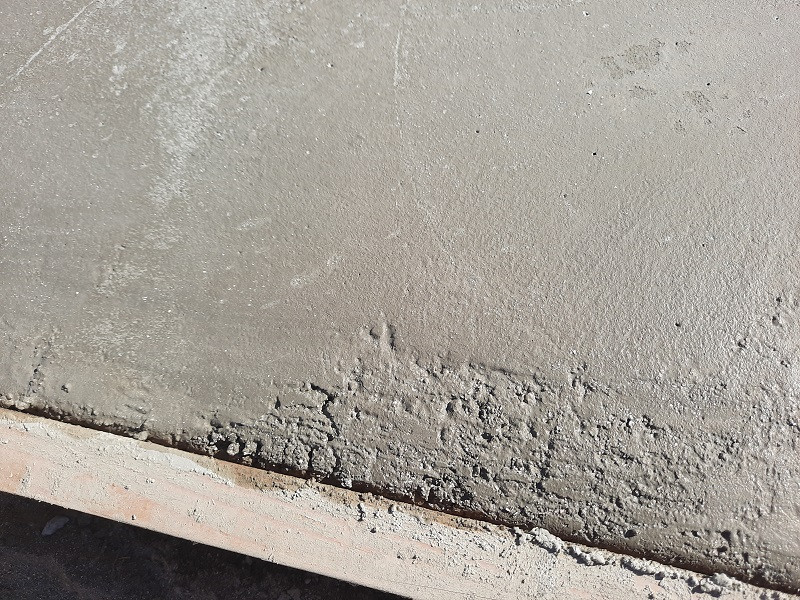
Last year, a major third-party logistics (3PL) provider in South Dallas called our commercial foreman in absolute panic. They had recently leased a massive, newly constructed warehouse facility, but the original general contractor had severely botched the interior slab pour. The builder had utilized a cheap, highly diluted concrete mix to save money on placement labor. After just three months of standard forklift traffic, the surface paste of the concrete was actively delaminating, and the edges of the control joints had curled upward by nearly half an inch. Every time a reach truck hit those curled joints, it shattered the concrete further.
Rescuing a Botched Industrial Facility Pour
The facility manager was losing thousands of dollars a week to destroyed forklift wheels and dropped inventory. We stepped in to execute a massive, phased structural intervention. We mobilized our heavy-duty planetary grinders to shave down the curled edges of the slab until the floor was completely flat. Because the original joints were utterly destroyed, we routed them out deeply with V-blade diamond saws and injected a structural industrial epoxy to restore load transfer across the panels. Finally, we applied a liquid densifier to chemically harden the weak surface paste. We rescued the facility from a catastrophic construction error, transforming a rapidly deteriorating liability into a high-functioning, traffic-ready distribution floor without forcing them to shut down their outbound shipping lanes.
The Devastating Cost of Skipping Sub-Slab Vapor Retarders
A rampant, catastrophic flaw in the Dallas commercial contracting market is the deliberate omission of heavy-duty sub-slab vapor retarders. To save a marginal amount of money on materials, discount commercial builders will frequently pour warehouse floors directly over the crushed rock base without installing a plastic moisture barrier. In the Blackland Prairie, this is a fatal mistake. The dense clay holds massive amounts of groundwater. Due to differences in temperature and humidity, an invisible phenomenon known as vapor drive forces groundwater upward through the porous concrete slab. If you intend to apply an expensive industrial epoxy coating, urethane topcoat, or sensitive commercial flooring over that slab, the rising moisture will accumulate directly beneath the coating. This hydrostatic pressure inevitably causes massive osmotic blistering, completely delaminating the expensive topcoat and turning your warehouse floor into a peeling, sweating, dangerous slip hazard. We mandate the installation of high-performance, 10-mil or 15-mil polyolefin vapor retarders under every single commercial interior slab we pour. We meticulously tape every seam and seal every pipe penetration, ensuring absolute zero moisture intrusion into your facility.


Utilizing Advanced Plasticizers and High-Early-Strength Concrete
The defining characteristic of a premium commercial concrete slab is its compressive strength, typically measured in Pounds per Square Inch (PSI). To achieve the high PSI ratings required for industrial zones, the concrete mix must contain a very low water-to-cement ratio. However, a dry mix is incredibly thick, stiff, and difficult to pump across a massive warehouse footprint. The amateur solution is to simply add more water on the job site to make the concrete flow faster a practice that permanently dilutes the chemical bonds and ruins the structural integrity of the floor.
Controlling the Water-to-Cement Ratio
We completely reject the practice of watering down commercial concrete. Instead, we utilize advanced chemical admixtures, specifically high-range water reducers known as polycarboxylate plasticizers. These specialized chemicals instantly liquefy the concrete matrix without adding a single drop of actual water. This provides our placement crews with the necessary slump and workability to efficiently screed massive square footage while maintaining the strict, low water-to-cement ratio required to achieve absolute maximum density. We pair these plasticizers with high-early-strength concrete mixes, allowing the slab to reach a verified 4,000 to 6,000 PSI rating rapidly, enabling you to get your heavy equipment onto the floor days ahead of a standard construction schedule.

Strict Adherence to ACI 302.1R Commercial Floor Guidelines
Pouring an industrial slab is an exact science governed by strict engineering parameters. We do not rely on guesswork or outdated field habits; we execute every commercial pour in strict accordance with the American Concrete Institute (ACI) 302.1R Guide for Concrete Floor and Slab Construction. These rigorous national standards specify the exact mathematical requirements for panel sizing, joint spacing, and load-transfer devices. For example, ACI guidelines dictate that control joints must be spaced at intervals of no more than 24 to 36 times the slab thickness to effectively manage shrinkage cracking. We strictly follow these parameters, utilizing early-entry diamond saws to cut precise joints at the exact right moment of the curing phase. Furthermore, we implement engineered steel dowel baskets at all construction joints to ensure positive load transfer between adjacent concrete panels, preventing vertical faulting when heavy forklifts cross the seam. Our absolute adherence to these recognized engineering standards guarantees your slab will pass the most rigorous municipal inspections and structural engineering audits in Dallas.
Our 3-Step High-Capacity Industrial Slab Installation Process
Executing a commercial flatwork project requires heavy logistical coordination, massive equipment mobilization, and an uncompromising sequence of operations. We utilize a highly refined, three-step installation process to deliver flawless industrial floors on time and on budget.
Achieving Laser-Precise Floor Flatness (FF/FL)

Step One is Subgrade and Vapor Barrier Placement.
We achieve optimal soil compaction densities, meticulously install the heavy-duty vapor retarder, and place the specified grid of deformed steel rebar or post-tensioning cables.
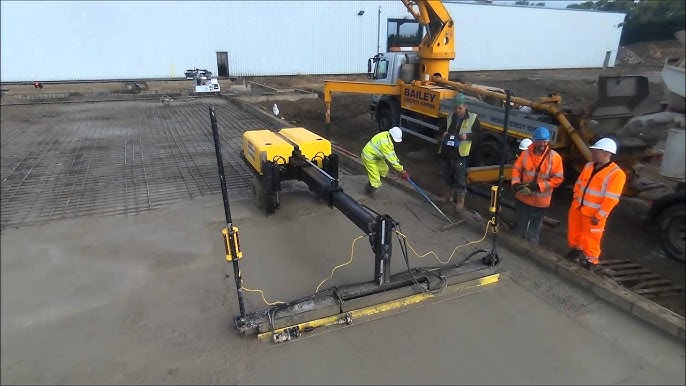
Step Two is the Laser-Guided Screeding and Pouring.
This is where our technological advantage shines. We deploy advanced, ride-on laser screed machines that read digital elevation data 10 times per second. These machines strike off the wet concrete with absolute mathematical precision, allowing us to achieve the exceptionally high Floor Flatness (FF) and Floor Levelness (FL) values required by automated material-handling systems.

Step Three is the Industrial Epoxy Control Joint Filling
After the slab has cured and undergone its initial volumetric shrinkage, we return to route out the saw cuts and inject semi-rigid industrial epoxy or polyurea joint fillers. This critical step supports the joint edges, preventing spalling caused by the impact of hard polyurethane forklift wheels.
Engineering Flat Floors Even on Unstable Texas Clay
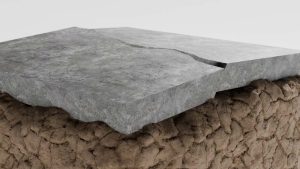
The most challenging aspect of commercial construction in the Dallas Metroplex is the ground itself. You might be planning to build a massive new manufacturing facility, but you know the site sits directly on highly volatile, expansive Vertisol clay. Facility managers are terrified that the unpredictable soil will inevitably shift, causing their multi-million dollar concrete floor to heave, crack, and drop out of level. This is a valid fear, but it is one we know exactly how to defeat.
Defeating Volatile Blackland Prairie Soil
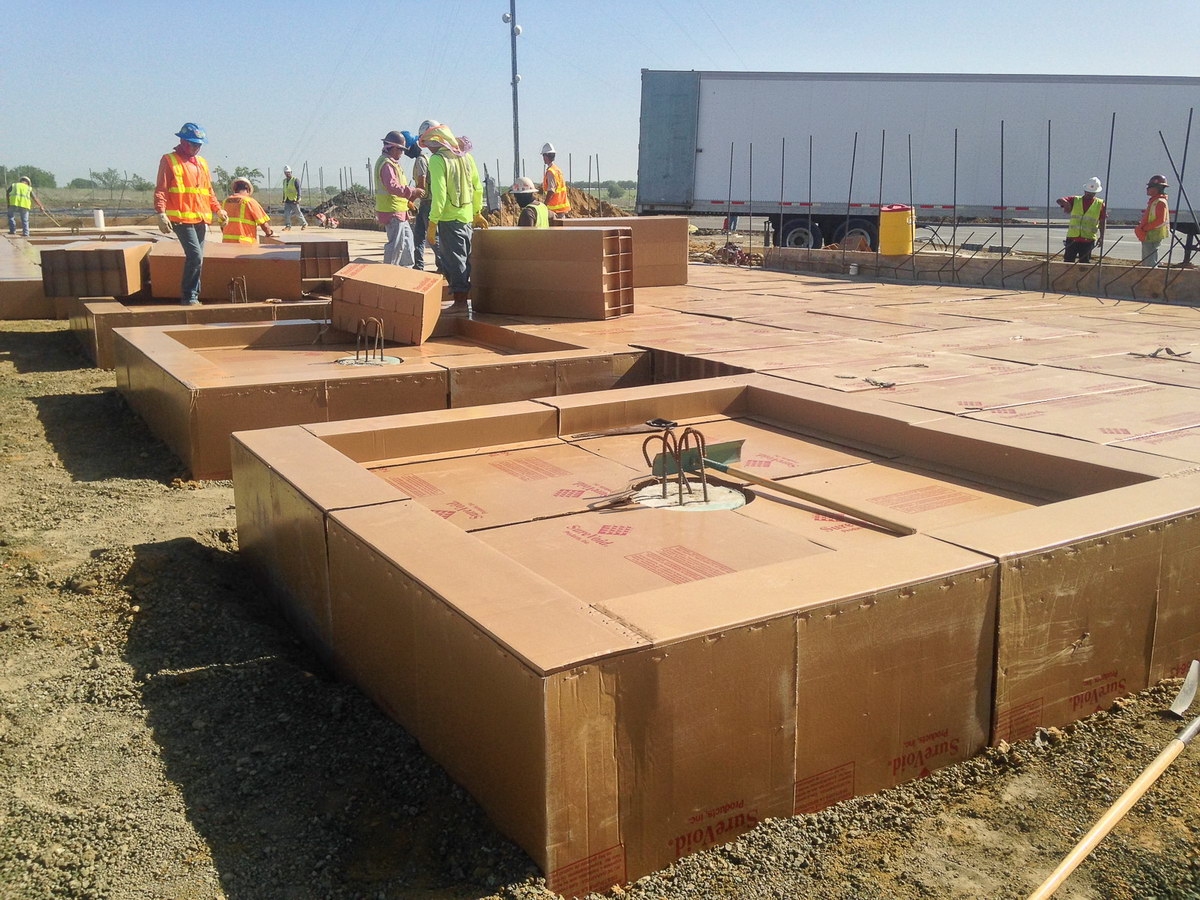
We can pour your warehouse floor perfectly flat and ensure it stays that way, even if the native Dallas clay is highly unstable. The secret lies in our aggressive geotechnical subgrade preparation. We never pour commercial slabs on raw, untreated Texas dirt. During the site preparation phase, we execute deep soil stabilization. This often involves chemical moisture conditioning or lime stabilization, where we blend hydrated lime directly into the top layers of the clay to permanently alter its chemical structure, reducing its shrink-swell potential to near zero. We then import heavy crushed rock, frequently integrating layers of high-tensile Tensar geogrid to lock the aggregate base into an unyielding, rigid platform. We conquer the bad soil before the concrete trucks ever arrive.
Upgrading 1970s Tilt-Wall Plants vs. New Mega-Distribution Centers
The commercial building stock across Dallas dictates exactly how we approach structural slab engineering. If we are contracted to upgrade an aging 1970s tilt-wall manufacturing plant along the Trinity River industrial corridor, we are dealing with floors engineered for much lighter, manual operations. When these older facilities try to install modern, heavy robotic automation or massive CNC machinery, the existing slab simply cannot bear the load. For these retrofits, we execute deep trenching, tear out the inadequate concrete, and pour heavily reinforced, isolated equipment pads designed to absorb massive mechanical vibration. Conversely, when we bid on brand-new, million-square-foot e-commerce fulfillment centers in South Dallas or Alliance Texas, the challenge is sheer scale. These massive buildings require highly orchestrated, continuous pours moving thousands of yards of concrete per day. We manage the immense logistics of continuous ready-mix delivery, deploying multiple laser screeds and large finishing crews to ensure the floor cures uniformly, with no cold joints or structural defects.
The Physical Impact of a Perfectly Level Warehouse Floor
The quality of an industrial concrete slab dictates the physical environment of the entire facility. If you currently operate a warehouse with a failing, uneven floor, your employees experience that failure every single minute of the shift. You can hear the jarring, violent clatter of metal forks and the terrifying rattle of palletized inventory every time a lift truck bounces over a curled, spalling joint. The operators physically feel the sharp, spine-compressing vibration traveling straight up through the steering column, which directly contributes to widespread ergonomic fatigue and expensive workers’ compensation claims. Replacing that failing slab with a precision-engineered, laser-flat surface completely transforms the building’s acoustic and physical profile. The violent clatter is silenced, replaced by the smooth, quiet hum of polyurethane wheels gliding effortlessly across an unbroken plane. Your operators can safely maximize their transit speeds, your high-reach equipment stops swaying dangerously in the aisles, and the overall efficiency of your logistics operation increases dramatically simply because the floor is finally working with your team, not against them.
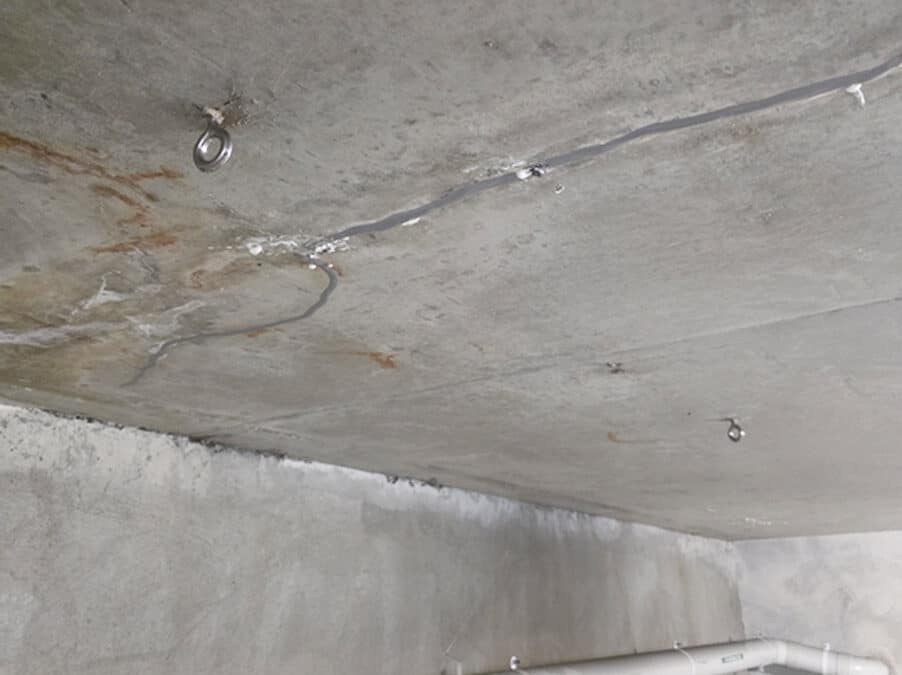
When a warehouse floor begins to fail, corporate maintenance budgets often dictate the cheapest possible immediate response. A massive mistake we constantly encounter in Dallas commercial real estate is the attempt to fix a spalling, dusting, or curling concrete slab by simply rolling a layer of cheap, cosmetic floor paint or thin epoxy over the damage. This is a severe miscalculation. Paint possesses absolutely zero structural compressive strength. It cannot bridge a widening control joint, and it certainly cannot support the edge of a curled concrete panel when a 10,000-pound forklift rolls over it.
The structural movement of the slab will instantly crack the cosmetic coating. Furthermore, if the concrete is dusting due to a weak surface paste, the paint will have nothing solid to bond to and will peel off in massive, unsightly sheets within weeks. This peeling paint quickly becomes a massive OSHA slip-and-fall hazard for your warehouse staff and gets tangled in your expensive floor-sweeping machines. A structural concrete failure demands a structural concrete intervention. You must rely on deep mechanical grinding, chemical densification, and heavy-duty polyurea joint fillers to actually repair the matrix, rather than hiding it behind a useless coat of gray paint.
Why Cheap Epoxy Paints Cannot Fix Structural Slab Curling
Managing Massive Continuous Pours in Active Distribution Hubs
Industrial concrete replacement rarely occurs in an empty building; it usually must be carried out while the surrounding business continues to operate. Facility directors are rightfully terrified that bringing a fleet of cement trucks and heavy finishing equipment into their building will completely disrupt their inbound freight lanes, block their active loading docks, and paralyze their shipping quotas. We specialize in dynamic B2B project management to eliminate this operational friction.
Flawless B2B Construction Phasing
We understand that your business cannot stop. We meticulously sequence our demolition and pouring operations into highly contained, strategic phases. We erect physical dust barriers to protect your adjacent inventory and coordinate our access routes to ensure your trucks can still reach the active dock doors. We seamlessly synchronize our schedules with your steel erectors, racking installers, and MEP (mechanical, electrical, and plumbing) contractors so that our curing timelines never create bottlenecks for the other trades. When necessary, we execute massive overnight or weekend continuous pours, using the facility’s lowest-traffic windows to complete the heavy placement, ensuring your third-shift logistics teams experience zero delay.

Calculating the True Total Cost of Ownership for Industrial Floors
Procuring a commercial concrete slab based solely on the lowest initial bid is a guaranteed path to massive long-term financial loss. In the heavy-industrial sector, the true Total Cost of Ownership (TCO) is measured over decades of active use. If you hire a discount contractor who skips the vapor barrier, uses a diluted 3,000 PSI mix, and cuts the joints too late, you might save ten percent upfront. However, within two years, you will spend tens of thousands of dollars replacing shredded forklift tires, repairing damaged VNA truck suspensions, and paying specialty contractors to constantly inject expensive polyurea into the failing, spalling joints. Every hour an aisle is shut down for emergency floor repair is lost revenue. By investing in a high-tolerance, heavily reinforced,
ACI 302.1R-compliant slab from the very beginning, you effectively zero out your long-term maintenance budget. We operate with absolute financial transparency. We provide comprehensive B2B estimates detailing the exact cubic yardage of 4,000 PSI concrete, the tonnage of steel reinforcement, and the costs associated with hitting your specific FF/FL tolerance requirements, ensuring you understand exactly what you are paying for and why it matters.

Your Technical Authority for Dallas Commercial Concrete Slabs
Your commercial facility’s concrete floor is the literal bedrock of your enterprise’s logistics, manufacturing, and revenue generation. When extreme Dallas heat, shifting Vertisol clay, and heavy material handling equipment threaten the integrity of your operations, you cannot afford to hire residential contractors lacking industrial expertise. Urban Concrete & Construction is the definitive technical authority on high-capacity commercial concrete slabs in the Dallas Metroplex. We combine high-early-strength mixes, polycarboxylate plasticizers, and precision laser screeding to deliver floors that exceed ACI 302.1R guidelines. Dispatched from our hub near the Dallas Design District, we navigate complex B2B phasing, mandate heavy-duty vapor retarders, and engineer slabs that withstand the most punishing 20,000-pound stationary racking point loads. Stop letting a failing, curled warehouse floor destroy your material-handling equipment and slow down your supply chain. Invest in unyielding structural performance. Contact our commercial estimating team right now to schedule a comprehensive facility assessment, and let us pour the heavy-duty industrial floor your business requires to operate at maximum velocity.
Frequently Asked Questions About Commercial Concrete Slabs
How much does an engineered commercial concrete slab cost per square foot in Dallas?
The average cost is $6 to $12 per square foot for standard commercial slabs, rising to $10 to $18 per square foot for heavy-duty industrial applications. In Dallas, the exact price is determined by the cubic yardage of high-early-strength concrete, the slab thickness, and the required tonnage of steel reinforcement. Urban Concrete & Construction provides detailed B2B estimates that include laser screeding and moisture mitigation, ensuring absolute financial transparency.
Does the City of Dallas require a vapor retarder under commercial concrete floors?
Yes, current Dallas Building Code amendments and ACI 302.1R guidelines mandate a Class A vapor retarder under interior concrete slabs that will receive moisture-sensitive finishes. Skipping this barrier allows hydrostatic pressure and vapor drive to push groundwater up through the porous concrete, causing massive osmotic blistering in expensive epoxy topcoats. Urban Concrete & Construction installs heavy-duty 10-mil or 15-mil polyolefin vapor barriers with fully taped seams to ensure zero moisture intrusion.
What FF/FL numbers are required for a Dallas warehouse using Very Narrow Aisle (VNA) forklifts?
You must achieve a minimum Floor Flatness (FF) of 50 and Floor Levelness (FL) of 30 to safely operate Very Narrow Aisle (VNA) forklifts. Standard strike-off methods achieve only FF 20-25, causing dangerous mast sway and limiting the operational speed of high-reach equipment. Urban Concrete & Construction utilizes advanced ride-on laser screeds reading digital elevation data to strictly meet and exceed these high-tolerance ACI 302.1R flatness specifications.
How thick should a commercial concrete slab be to support 20,000-pound racking systems?
A commercial concrete slab must be at least 6 to 8 inches thick to safely support standard industrial loads, while extreme 20,000-pound stationary racking requires a 10-inch thickness. The concentrated point-load pressure from steel baseplates will cause punching shear failure if the concrete matrix is too thin. Urban Concrete & Construction engineers the specific depth and #4 to #6 rebar grid based on the geotechnical bearing capacity of your compacted aggregate subbase.
Is polyurea or epoxy better for filling control joints in an active warehouse in Dallas?
Polyurea is vastly superior to epoxy for active distribution centers because it cures in just 15 minutes and can be applied in freezing temperatures. While both materials achieve the required 80-85 Shore A hardness dictated by ACI standards, industrial polyurea offers slightly greater elastomeric flexibility to absorb kinetic shock from hard polyurethane forklift wheels without welding the slabs together. Urban Concrete & Construction injects these semi-rigid fillers to prevent joint nose spalling.
How long must a 4,000 PSI commercial concrete slab cure before supporting heavy forklift traffic?
It takes 28 days for a standard commercial concrete slab to reach its fully cured structural capacity. However, utilizing high-early-strength concrete mixes allows light foot traffic within 24 hours and standard warehouse operations within 7 to 14 days, depending on the specific plasticizers used. Urban Concrete & Construction closely monitors internal slab temperatures and hydration rates to inform facility managers exactly when 10,000-pound material handling equipment can safely resume operation.
How do you stabilize Dallas Blackland Prairie clay before pouring a heavy-duty industrial slab?
You must use chemical moisture conditioning or lime stabilization to permanently alter the expansive properties of Dallas Blackland Prairie clay. Pouring concrete directly onto volatile Vertisol clay guarantees severe structural deflection and cracking when the soil absorbs stormwater. Urban Concrete & Construction blends hydrated lime into the topsoil and imports TxDOT-approved crushed rock, often utilizing high-tensile Tensar geogrid to create a rigid, unyielding platform before pouring the slab.