
Urban Concrete & Construction
Replace Your Melting Dallas Asphalt With A Heavy-Duty Concrete Parking Lot That Requires Zero Summer Maintenance.
We pour 6-inch continuously reinforced concrete parking lots that strictly comply with the City of Dallas Paving Design Manual.
Commercial Underpinning and Geotechnical Stabilization in Dallas
When extreme North Texas heat and heavy delivery trucks destroy your asphalt, patching is a waste of capital. We engineer heavy-duty commercial concrete parking lots in Dallas, replacing melting blacktop with rigid, 6-inch reinforced pavement. We completely eliminate your annual maintenance budget and deliver a permanent, high-capacity traffic solution.
For property managers and commercial real estate investors, the parking lot is often the largest physical asset on the property outside of the building itself. When that asset degrades into a cratered, rutted mess, it instantly damages your brand reputation and introduces severe premises liability hazards. Choosing to pave with concrete rather than asphalt completely changes the financial and functional trajectory of your property. We do not lay temporary blacktop; we construct highly engineered, structural concrete slabs designed to carry the immense weight of commercial logistics. By utilizing continuous reinforcement and achieving strict subgrade compaction, we deliver a surface that refuses to warp, melt, or shear under the punishing conditions of the Dallas Metroplex. This geotechnical upgrade secures your property lines, ensures perfect stormwater drainage, and provides your tenants with a pristine, immovable surface that performs flawlessly for decades without the constant interruption of maintenance crews.

Conquering the Unrelenting Dallas Summer Heat
Operating a commercial property in the Dallas Metroplex means subjecting your exterior infrastructure to brutal, unrelenting thermal abuse. During our peak summer months, when ambient temperatures consistently exceed 100 degrees, the surface temperature of dark asphalt can easily skyrocket to 140 degrees or more. At these extreme temperatures, the petroleum binders inside flexible asphalt literally begin to melt, turning the solid surface into a soft, pliable sludge. When a heavy delivery truck or a loaded garbage truck turns its wheels on this softened material, it physically tears the pavement apart, creating deep ruts and shoving the asphalt into dangerous, uneven mounds. Operating across the primary business corridors of the city from the dense retail centers along North Central Expressway to the sprawling industrial parks near Stemmons Freeway, we witness this exact structural failure every single day. We pour concrete because it is a rigid pavement that entirely rejects this thermal degradation.
Concrete has a high heat-reflective index, meaning it reflects solar radiation back into the atmosphere rather than absorbing it. Your parking lot remains structurally solid, significantly cooler, and entirely immune to the melting and rutting that plagues every asphalt surface in North Texas.
Halting the Endless Cycle of Pothole Repairs
Two years ago, we were contacted by a property management group overseeing a high-traffic retail shopping center near the North Central Expressway. Their massive asphalt parking lot was in terminal decline. Decades of heavy delivery trucks, constant tenant traffic, and poor subgrade drainage had resulted in a landscape riddled with deep, jagged potholes. The property manager was trapped in an infuriating cycle: every three months, they paid a crew to fill the holes with cold patch, and after the next heavy rainstorm, the patches washed out completely, leaving the lot more dangerous than before. Tenants were complaining, and customers were damaging their suspensions.
Executing a Permanent Structural Replacement
We stepped in and stopped the bleeding. We executed a full-depth reclamation, using heavy milling machines to tear out the ruined asphalt and excavate the saturated clay beneath. We treated the failing soil with lime stabilization to lock the subgrade in place. Then we poured a continuously reinforced 6-inch concrete parking lot with integrated concrete curbs and heavy-duty approach aprons. The transformation was absolute. The property manager eliminated their quarterly patching budget entirely, the tenants were thrilled with the clean, bright aesthetic, and the constant threat of vehicular damage was permanently erased. We replaced a constant financial drain with a fixed, high-performing asset.

Avoiding the Deceptive Asphalt Overlay Trap
One of the most expensive mistakes a commercial property owner can make is falling for the deceptive “asphalt overlay” trap. When an old parking lot begins to show widespread “alligator cracking” and base failure, many discount paving contractors will advise the owner to simply pave a new, two-inch layer of blacktop directly over the old, ruined surface. They sell this as a fast, cost-effective facelift. In reality, it is a catastrophic waste of capital.
The Inevitability of Reflective Cracking
When the subgrade and the original base layer have already failed, laying a thin sheet of new asphalt on top does absolutely nothing to fix the structural deficit. Because the earth beneath the lot is still shifting, the old, cracked asphalt underneath will continue to move. Within 12 to 24 months, a phenomenon known as “reflective cracking” occurs: every single crack in the old pavement mirrors its way straight up through the brand-new surface. You end up right back where you started, having wasted tens of thousands of dollars on a cosmetic illusion. We refuse to participate in this scam. We address the pavement lifecycle honestly, pushing for full-depth demolition and structural concrete replacement that solves the geotechnical failure at its root, rather than hiding it under a temporary rug.

Engineering 6-Inch Continuously Reinforced Pavement
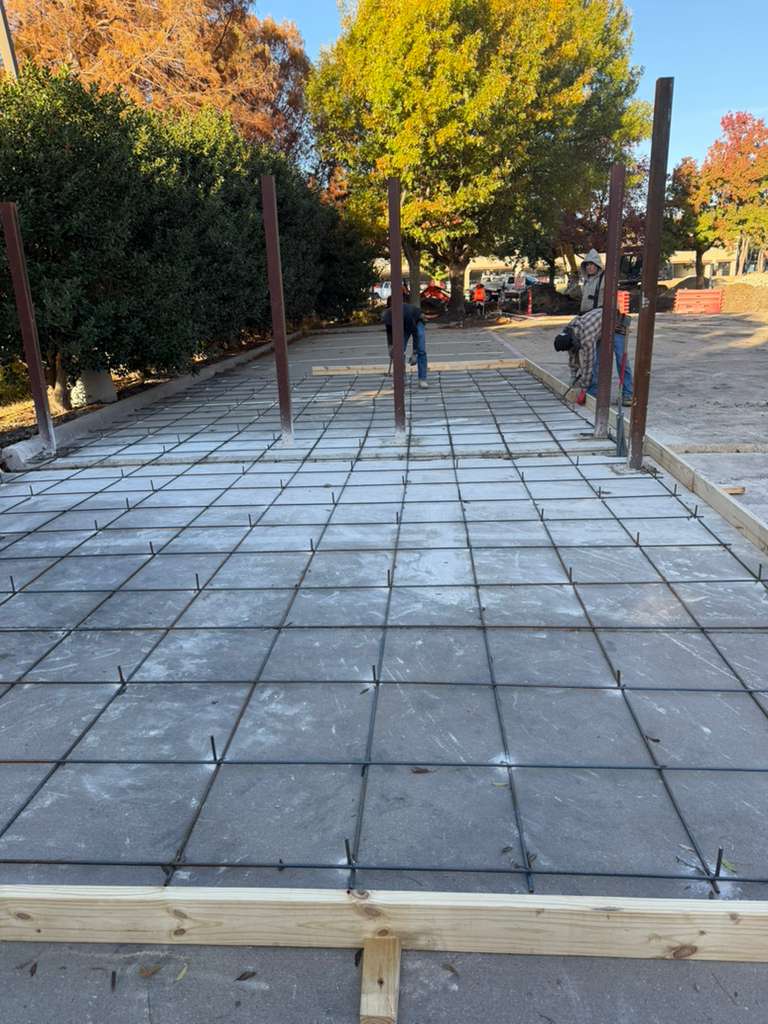
Constructing a commercial concrete parking lot requires precise material engineering to guarantee long-term performance. We do not use weak residential mixtures or thin profiles for our commercial flatwork. Every parking lot we install features a minimum slab thickness of 6 inches, specifically tailored to handle the repetitive stress from passenger vehicles and medium-duty delivery trucks. In zones that experience extreme stress, such as loading docks, main thoroughfare entrances, and commercial dumpster pads, we thicken the concrete profile to 8 or even 10 inches to prevent punching shear failure from heavy sanitation trucks.
The Superiority of Deformed Steel Rebar
To give the rigid pavement the necessary tensile strength, we mandate continuous reinforcement. We completely avoid flimsy-welded wire mesh, which rusts rapidly and provides inadequate structural support. Instead, we tie a tight, continuous grid of #3 or #4 deformed steel rebar. These heavy steel bars physically lock into the 4,000 PSI concrete matrix as it cures, creating a monolithic diaphragm that aggressively resists the bending forces of Texas soil heave and the lateral friction of turning tires. This heavy-duty material specification is the exact reason our lots survive for decades without cracking under pressure.

Upgrading Your Lot Even If You Cannot Shut Down
A massive logistical hurdle that prevents many retail centers and commercial offices from replacing their failing pavement is the fear of business interruption. You might manage an active shopping plaza and assume that tearing out the entire parking lot means forcing your tenants to close their doors for three weeks, leading to furious business owners and lost revenue. We have engineered our project management protocols to completely overcome this objection. We can upgrade your entire parking facility without ever shutting down your business.
Implementing Multi-Phase Traffic Control
We execute commercial paving projects through highly strategic, multi-phase traffic control plans. Before any demolition begins, we map out temporary traffic lanes and alternative access points. We barricade and tear out only specific, isolated sections of the lot at a time. While we excavate and pour Zone A, your customers safely navigate through Zone B. By utilizing high-early-strength concrete mixes, we can achieve traffic-ready compressive strength in a fraction of the standard time, allowing us to rapidly reopen the newly poured sections and move our barricades to the next zone. We synchronize the movements of our heavy machinery to ensure your tenants remain open, accessible, and profitable throughout the entire construction lifecycle.
Our 3-Step Commercial Paving Protocol
Delivering a massive, heavy-duty concrete parking lot on schedule requires an uncompromising sequence of operations and intense logistical discipline. We execute a strict, three-step customer journey to guarantee flawless execution.
Minimizing Disruption with Rapid-Curing Mixes

Step One is Full-Depth Reclamation and Demolition.
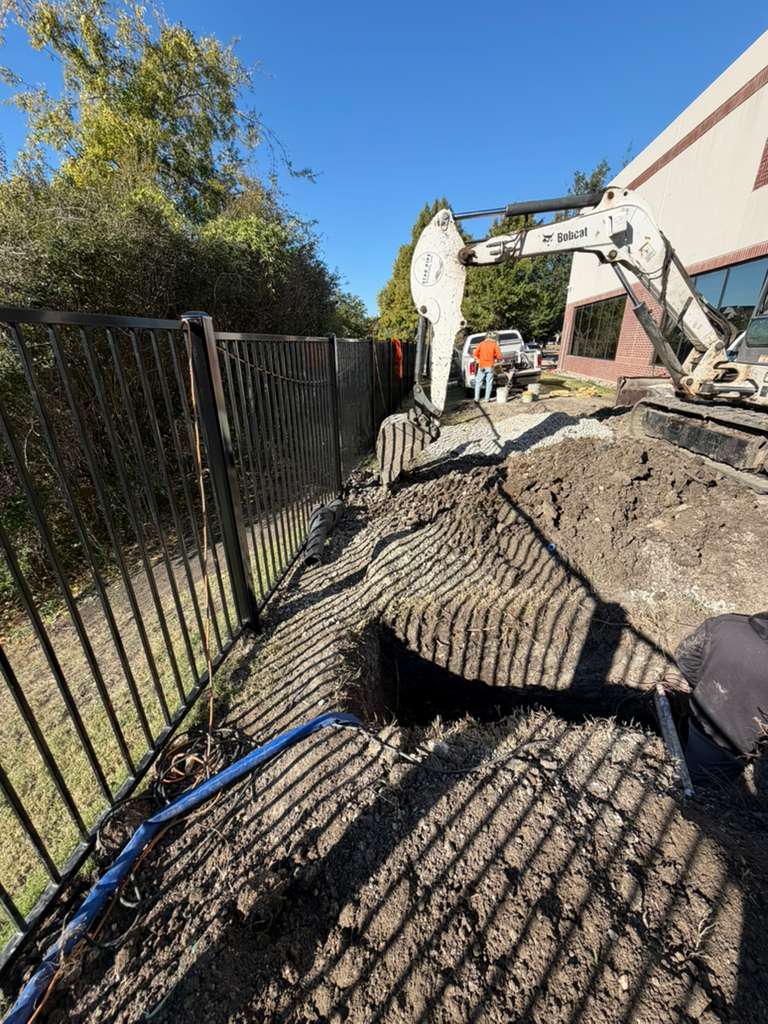
We deploy large-scale milling machines and excavators to completely strip away the failing asphalt, extracting the ruined material and hauling it off-site in heavy dump trailers. We never leave piles of toxic asphalt debris sitting in your active commercial space.

Step Two is Subgrade Stabilization.
We grade the exposed earth, treat the soil to mitigate expansion, and install a thick, compacted layer of TxDOT-approved crushed rock to serve as the unyielding foundation. We tie the continuous steel reinforcement grid and set the heavy-duty edge forms.

Step Three is the Laser-Screeded Pour and Striping.
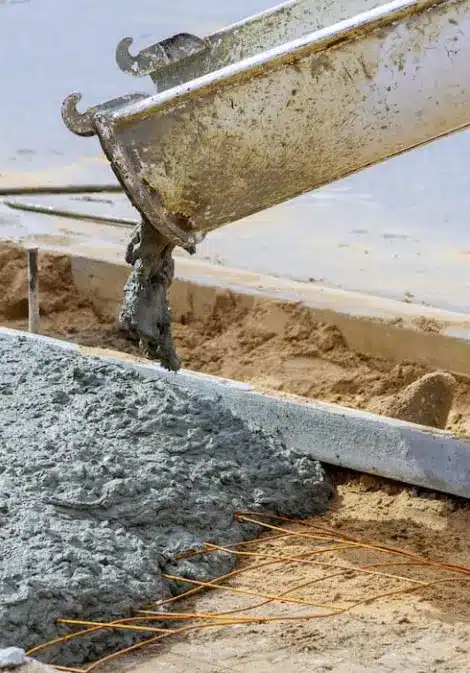
We orchestrate a continuous fleet of ready-mix trucks, pouring our 4,000 PSI concrete while utilizing advanced laser screeds to achieve perfect elevation and drainage slopes. Once the concrete has achieved its initial cure, we cut the critical expansion joints, apply the curing compound, and dispatch our striping crews to paint crisp, highly visible parking stalls, fire lanes, and directional arrows, delivering a fully turnkey commercial asset.
Implementing Lime Stabilization and Crushed Rock
The absolute number one fear commercial property developers face in North Texas is catastrophic soil failure. You know that investing hundreds of thousands of dollars into a new parking facility is entirely useless if the Blackland Prairie clay beneath it decides to heave and shatter the slabs after the first year. We address this fear head-on through aggressive geotechnical engineering. A concrete parking lot is only as strong as the dirt it sits on.

Chemically Altering the Native Clay
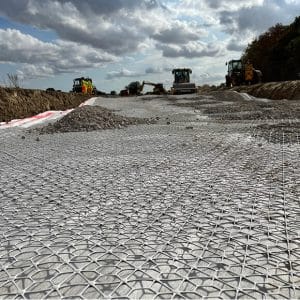
Before we ever lay a rock base, we frequently employ lime stabilization for large commercial lots. We use heavy machinery to till the top 6 to 8 inches of the native Vertisol clay, aggressively blending in hydrated lime and water. This triggers a chemical reaction that permanently alters the molecular structure of the clay, drastically reducing its plasticity and killing its ability to shrink and swell. Once the soil is chemically neutralized, we cap it with a deeply compacted layer of crushed limestone aggregate. This creates an unyielding, rock-solid platform that completely isolates your new concrete pavement from the underlying geology, guaranteeing decades of flawless structural performance.
Retrofitting 1980s Strip Malls vs. Modern Office Parks
The commercial architecture across Dallas is incredibly diverse, demanding highly adaptable paving strategies. If we are contracted to replace the parking lot of a 1980s strip mall in Garland or Mesquite, we are typically dealing with a severely sunken lot that has lost its original drainage slope. In these older retrofits, the project is heavily focused on water management. We must aggressively alter the subgrade elevation, install new concrete catch basins, and occasionally replace crushed corrugated drainage culverts to ensure the new concrete aggressively sheds stormwater into the municipal system. Conversely, when we bid on pouring massive flatwork for a brand-new, modern corporate office park in Frisco, the focus shifts to sheer scale and aesthetic integration. These modern lots require massive, continuous pours, precise integration with high-end commercial landscaping islands, and sleek, extruded-concrete curbs that define the modern corporate aesthetic. We possess the heavy machinery and the technical expertise to execute both complex drainage retrofits and massive new-build flatwork flawlessly.
Escaping the Annual Seal-Coating Scam
The asphalt paving industry relies on a highly lucrative, recurring revenue model built entirely on the inherent weakness of its product. When you install a blacktop parking lot, you are forced into an endless cycle of expensive maintenance known as the seal-coating trap. Because asphalt is a petroleum-based product, the intense UV radiation of the Dallas sun rapidly oxidizes the chemical binders. Within twelve months, the pavement turns gray, becomes brittle, and begins to crack. To prevent the lot from disintegrating entirely, paving contractors force you to pay for a chemical seal-coat every single summer, followed by the cost of completely re-striping all of your parking lines. Over ten years, you end up buying your parking lot three times over just to keep it functional. Upgrading to rigid concrete pavement completely destroys this predatory maintenance cycle. Concrete is naturally UV-resistant; it does not oxidize, it does not turn brittle in the sun, and it never requires a chemical seal-coat to maintain its structural integrity. You sweep it, pressure-wash it occasionally, and leave it alone. We free your commercial budget from the annual seal-coating scam.
The Visceral Difference of a Concrete Surface
The difference between an asphalt lot and a rigid concrete pavement is a highly visceral experience that directly impacts your customers the moment they step out of their vehicles. On a 105-degree August afternoon, walking across an aging asphalt lot is miserable. Your shoes stick to the soft, melting tar; the black surface radiates an oppressive, suffocating wave of thermal heat directly upward, and the air smells distinctly of hot petroleum. That massive heat sink actively raises the ambient temperature around your commercial building, forcing your HVAC units into overdrive. Concrete completely reverses this sensory nightmare. When your customers step onto our bright, light-reflective concrete slabs, the surface feels solid, clean, and noticeably cooler. There is no sticky tar to track into your retail stores, and the high solar reflectance drastically reduces the heat island effect around your building, creating a far more welcoming and comfortable environment for your patrons. It communicates a high-end, premium aesthetic that asphalt simply cannot match.

Compliance With the Dallas Paving Design Manual
Constructing a commercial parking facility in Dallas requires navigating a dense web of municipal engineering codes. The city dictates exactly how your pavement must perform to handle stormwater, accommodate emergency vehicles, and ensure public safety. We execute all of our commercial flatwork in strict compliance with the City of Dallas Paving Design Manual. This means we mathematically verify that our concrete thickness, compressive strength, and steel reinforcement schedules meet or exceed the city’s minimum requirements for heavy commercial traffic. Furthermore, we meticulously grade the surface to ensure cross-slopes do not exceed the 2% maximum allowed for ADA-compliant pedestrian routes, and we guarantee that the transition grades connecting to the municipal street are flawlessly executed. With the recent 2025/2026 Dallas Parking Reform eliminating rigid parking minimums, commercial property owners finally have the flexibility to redesign their lots for maximum efficiency rather than being constrained by arbitrary car counts. We help you capitalize on this new legislation, engineering a highly optimized, fully permitted concrete layout that perfectly serves your specific business needs without running afoul of Dallas Code Compliance.

Transparent Bidding Without Hidden Material Surcharges
When evaluating a massive commercial paving contract, asset managers require absolute financial clarity. We understand the concept of Total Cost of Ownership (TCO) and how it drives your capital expenditure decisions. While concrete requires a larger initial capital outlay than asphalt, the 20-year lifecycle cost shows it is the superior financial choice because the annual maintenance costs drop to zero. We provide completely transparent, B2B flat-rate proposals to help you make this calculation accurately.
Delivering Exact Estimating Metrics
We do not submit vague bids that leave room for massive material surcharges later in the project. Our commercial estimators utilize digital mapping and core samples to calculate the exact cubic yardage of 4,000 PSI concrete required, the precise tonnage of crushed rock for the subbase, and the exact linear footage of steel rebar. Your flat-rate quote covers the heavy demolition, lime stabilization, concrete placement, laser screeding, and final striping. You receive hard, reliable numbers that your corporate board can trust, ensuring your massive infrastructure upgrade stays strictly within the approved budget from day one.
Your Trusted Dallas Contractor for Rigid Pavement
Your commercial parking lot is a massive, high-visibility asset that requires heavy-duty engineering to survive the destructive combination of Dallas clay, extreme heat, and heavy delivery traffic. You cannot afford to rely on flexible asphalt that melts in the summer or contractors who cut corners on subgrade compaction. Urban Concrete & Construction is the premier technical authority in the Dallas Metroplex for continuously reinforced, rigid concrete pavement. We combine full-depth reclamation, lime stabilization, and 4,000 PSI structural slabs to deliver parking facilities that outlast the competition by decades. We expertly navigate the Dallas Paving Design Manual, manage complex, multi-phase traffic control to keep your business open, and eliminate the financial drain of annual seal-coating forever. Stop wasting your maintenance budget on temporary pothole patches. Upgrade to a permanent, high-capacity structural solution. Contact our commercial estimating team right now to schedule a comprehensive pavement assessment, and let us engineer the heavy-duty concrete parking lot your property demands.
Frequently Asked Questions About Commercial Parking Lot Paving
How much does commercial concrete parking lot paving cost in Dallas?
The average cost is $6.00 to $8.00 per square foot for a standard 6-inch continuously reinforced concrete parking lot. In Dallas, the final capital expenditure depends on the required depth of the TxDOT-approved crushed rock subbase and the amount of lime stabilization needed for the underlying Vertisol clay. Urban Concrete & Construction provides transparent B2B flat-rate proposals that include heavy milling and laser screeding, completely eliminating hidden material surcharges.
How much longer does a concrete parking lot last compared to asphalt in Texas?
A heavily reinforced concrete parking lot lasts 30 to 50 years, which is more than double the 15-to-20-year lifespan of a standard asphalt lot. Because concrete is a rigid pavement with high solar reflectance, it does not undergo the rapid UV oxidation and thermal melting that destroys flexible blacktop. Urban Concrete & Construction eliminates your annual seal-coating budget by installing permanent structural slabs that drastically lower your Total Cost of Ownership (TCO).
Why do asphalt parking lots rut and melt during the Dallas summer?
Asphalt parking lots rut because the petroleum-based binders in the flexible pavement begin to melt when ambient temperatures push the surface temperature past 140 degrees. When a heavy garbage truck turns its wheels on this softened blacktop, the lateral friction physically shoves the material into uneven mounds. Urban Concrete & Construction replaces this failing material with light-reflective, rigid concrete pavement that remains completely solid and structurally intact regardless of the North Texas heat index.
How thick should a concrete parking lot be for heavy delivery trucks?
A commercial concrete parking lot must be a minimum of 6 inches thick, with high-stress areas like dumpster pads and loading docks requiring 8 to 10 inches of thickness. Standard 4-inch residential flatwork will suffer immediate punching shear failure under the 10,000-pound point loads of modern sanitation trucks. Urban Concrete & Construction engineers 4,000 PSI concrete slabs reinforced with #4 deformed steel rebar to safely distribute these massive commercial logistics loads.
What is the maximum cross-slope for ADA parking spaces under the Dallas city code?
The maximum allowable cross-slope for an ADA-compliant parking space and its adjacent access aisle is exactly 2.0%. Exceeding this strict mathematical threshold violates the Americans with Disabilities Act and the City of Dallas Paving Design Manual, exposing property managers to severe municipal fines and lawsuits. Urban Concrete & Construction utilizes digital laser levels and ride-on laser screeds to guarantee perfect, code-compliant grading across all pedestrian routes.
Do I need a City of Dallas permit to repave a commercial parking lot?
Yes, you must obtain a commercial paving permit from the City of Dallas Building Inspection Division before altering or replacing a commercial parking lot. Furthermore, any work that intersects the municipal street or public sidewalk requires a separate Right-of-Way (ROW) permit and approved traffic control plans. Urban Concrete & Construction manages this entire bureaucratic process, ensuring your new parking facility strictly complies with the updated 2025/2026 Dallas Parking Reform regulations.
How long must a concrete parking lot cure before heavy trucks can drive on it?
It takes 7 to 14 days of undisturbed curing time before a commercial concrete parking lot can safely support heavy delivery trucks. While the rigid pavement can handle standard passenger vehicles within 3 to 4 days, the 4,000 PSI concrete matrix requires additional time to achieve the ultimate compressive strength necessary to resist commercial shear forces. Urban Concrete & Construction utilizes high-early-strength concrete mixes to dramatically accelerate this timeline, minimizing disruption to your active retail tenants.
Is it safe to pour a commercial concrete parking lot during a 100-degree heatwave?
Yes, it is completely safe to pour massive commercial flatwork during extreme heat if the contractor utilizes proper thermal mitigation strategies. If the water-to-cement ratio evaporates too quickly, the slab will suffer severe shrinkage cracking and edge curling. Urban Concrete & Construction executes massive continuous pours during cooler nighttime hours and applies specialized liquid evaporation retarders to trap the moisture, ensuring your 4,000 PSI parking lot cures flawlessly in the Dallas summer.