
Urban Concrete & Construction
Secure Your Dallas Business Against ADA Lawsuits With Mathematically Precise Concrete Ramps And Sidewalks.
We deploy laser-guided grading to construct ADA-compliant commercial ramps, protecting your property from predatory litigation and municipal fines.
ADA-Compliant Commercial Wheelchair Ramps in Dallas
When shifting concrete creates an accessibility barrier, you face immediate federal litigation and municipal fines. We construct ADA-compliant commercial wheelchair ramps and sidewalks throughout Dallas, using digital laser-level grading to ensure precise 1:12 running slopes. We install permanent cast-in-place tactile paving and resolve city code violations promptly, ensuring full barrier-free access and protecting your business from liability.
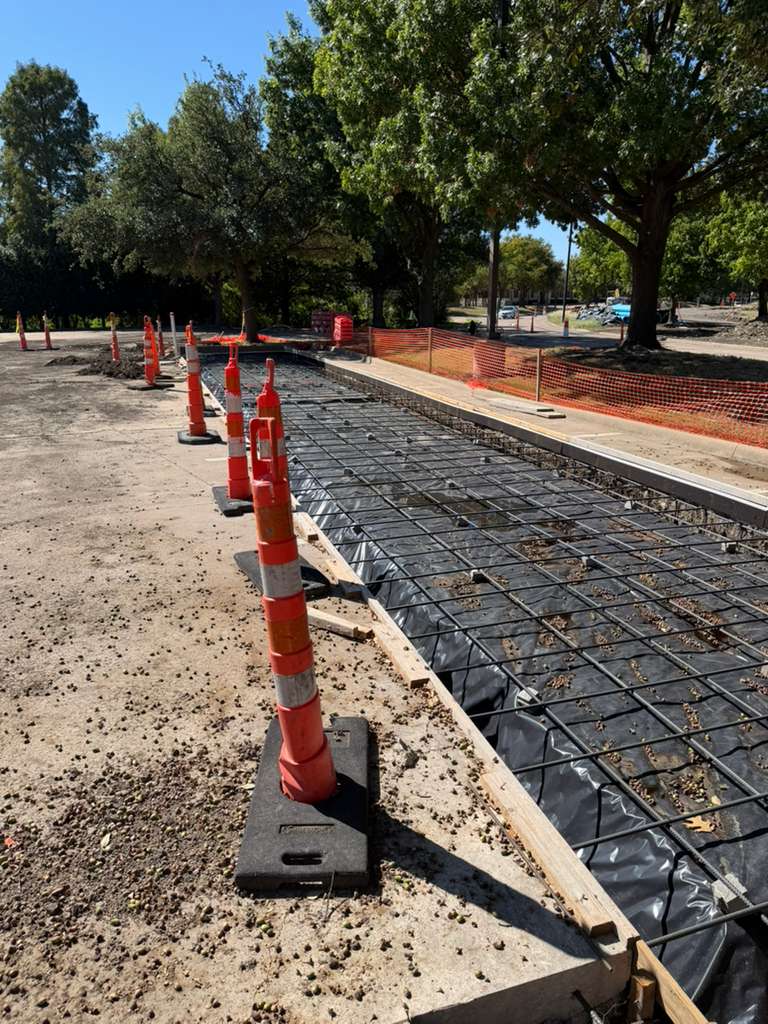

Surviving Blackland Prairie Soil Heave and Concrete Warping
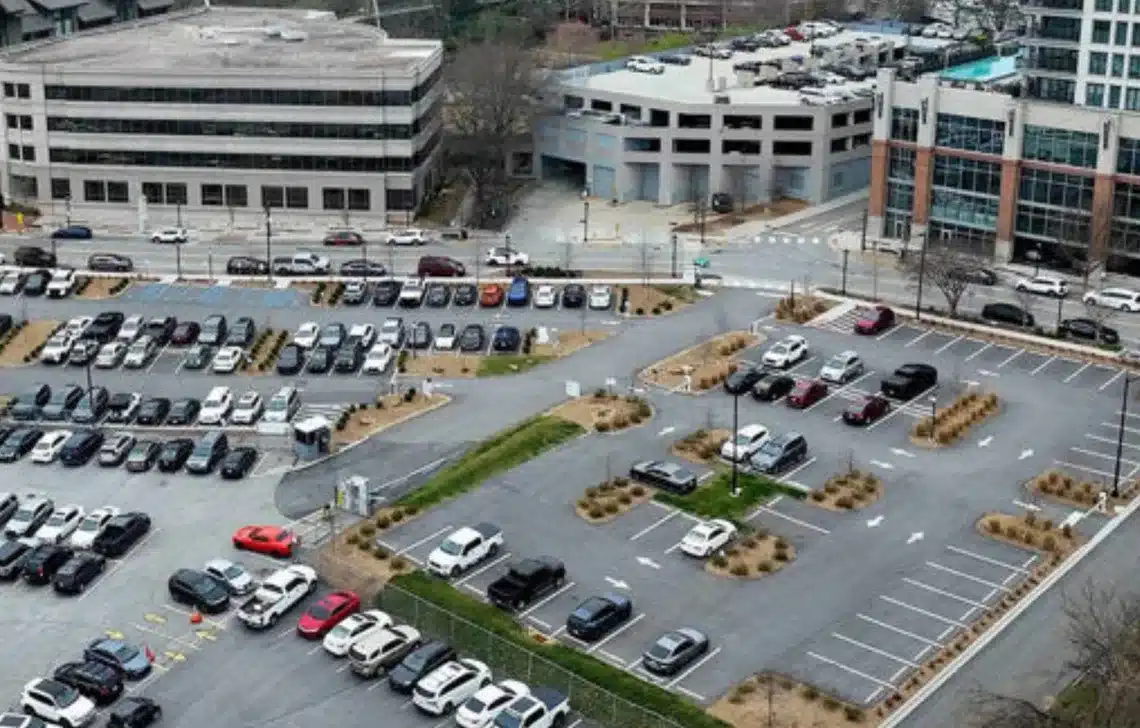
Rescuing a Greenville Avenue Retail Strip from Federal Litigation
Last October, a commercial property manager overseeing a busy retail strip center on Greenville Avenue contacted us in absolute panic. They had just been targeted by an aggressive ADA “drive-by” lawsuit. The plaintiff’s attorney measured the property’s primary wheelchair ramp and found that decades of soil settlement had warped the running slope to a dangerously steep 1:8 ratio, far exceeding the federal maximum. The property was facing devastating financial penalties and forced closure of the main entrance if the hazard wasn’t corrected immediately.
Beating the Litigation Deadline
We recognized the severity of the legal threat and deployed our commercial concrete team that Friday evening. We used hydraulic breakers to demolish the non-compliant slab, excavated the compromised clay, and set new wooden forms with digital smart levels to ensure absolute precision. By Sunday afternoon, we had poured a heavily reinforced, perfectly graded ramp featuring an exact 1:12 slope. The property manager submitted our mathematical slope verification to the city inspector and the opposing counsel on Monday morning, instantly neutralizing the lawsuit and keeping their retail tenants open for business.
The Brutal Financial Reality of Strict Liability ADA Litigation
Navigating commercial property ownership requires understanding that the Americans with Disabilities Act (ADA) operates on a strict liability basis. This is a critical legal distinction that many business owners fail to grasp until they are served with papers. Under strict liability, your intent does not matter. It does not matter if you were unaware that the ground shifted, or if you thought the ramp looked “close enough” to flat. If an inspector or a plaintiff’s attorney places a digital level on your commercial sidewalk and finds a quarter-inch vertical deviation or a cross-slope that exceeds two percent, you are automatically in violation of federal civil rights law. This single mathematical failure opens your corporate entity up to devastating discrimination lawsuits, massive financial settlements, and immediate stop-work orders from the Dallas Code Compliance department. You cannot negotiate with gravity, and you cannot argue your way out of a laser-level measurement. Precision concrete engineering is your only line of defense against predatory litigation. Securing a mathematically verified, code-compliant path of travel is the ultimate insurance policy for your commercial real estate investment.

The Severe Danger of the Amateur "Eyeball" Grading Approach
A massive vulnerability in the Dallas commercial contracting market is the reliance on outdated residential tools for highly regulated municipal flatwork. When a discount contractor bids on an ADA ramp replacement, they frequently attempt to grade the slope using an old, warped wooden two-by-four and a cheap plastic bubble level purchased at a hardware store. This “eyeball” approach is a catastrophic gamble with your liability.
A bubble level cannot measure the exact 8.33 percent running slope required for a compliant wheelchair ramp, nor can it accurately verify the strict 2.0 percent maximum cross-slope on the landing pad. When the City of Dallas Public Works inspector arrives with a highly calibrated digital smart level, that contractor’s guesswork will instantly fail the inspection. The city will immediately issue a red tag, forcing you to pay for the demolition of the brand-new concrete and completely restarting the project. We eliminate this costly amateurism. Our commercial crews utilize advanced laser-guided screeds and highly calibrated digital slope meters at every stage of the forming and pouring process, ensuring the wet concrete cures precisely within legal mathematical thresholds.
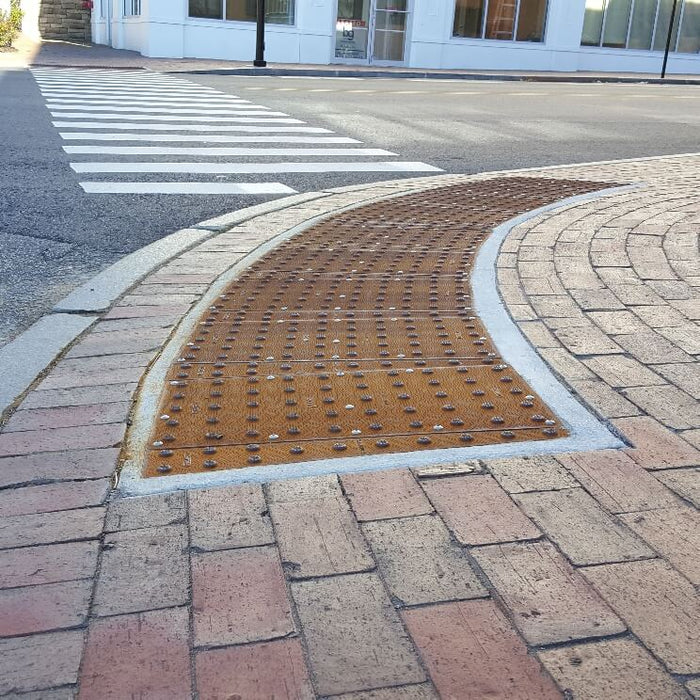
Upgrading to Heavy-Duty Iron Truncated Domes
Achieving ADA compliance requires more than just correct angles; it also requires installing specific safety hardware, most notably detectable warning surfaces at the base of the ramp. The industry standard for cheap contractors is to pour the concrete, let it dry, and then glue down flimsy, yellow plastic tactile mats. In the brutal environment of North Texas, this is a terrible investment. The intense 100-degree Dallas summer heat rapidly degrades industrial adhesives, while heavy delivery hand trucks catch the edges of the plastic. Within a single year, those plastic mats peel off, curl upward, and become a severe tripping hazard themselves, putting you right back into code violation.
Installing Permanent Tactile Paving Systems
We categorically refuse to install glued-on plastics. We engineer permanent tactile paving systems by utilizing heavy-duty, cast-in-place iron truncated domes. While the 4,000 PSI concrete is still in its wet, plastic state, we embed these heavy metal plates directly into the matrix. The concrete cures around the iron anchors, permanently locking the warning surface into the slab. This industrial-grade material withstands decades of heavy commercial traffic, intense UV radiation, and severe weather without ever peeling or fading.
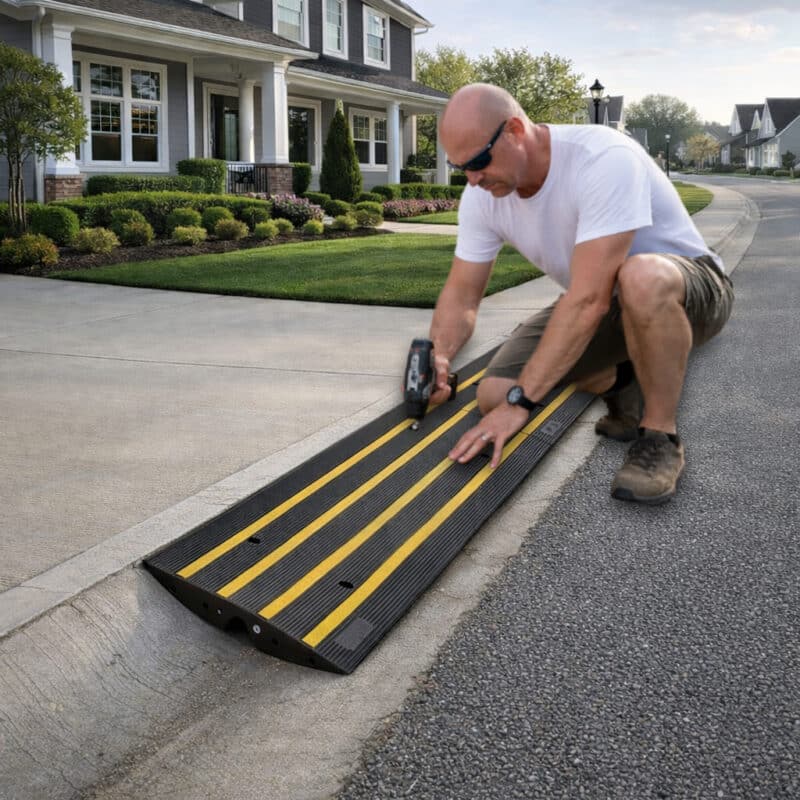
Achieving Compliance Even on Steep Front Elevations
A frequent objection we hear from commercial developers is the belief that their specific property layout makes compliance impossible. You might own a retail building that sits several feet above the street level, bordered by a short, steep grass embankment. You are terrified that building a ramp with a strict 1:12 slope will require tearing up half your parking lot just to achieve the required run.
We possess the structural engineering capabilities to address complex elevation challenges, ensuring we can achieve ADA compliance even if your building sits on steep, restrictive topography. We do not just pour straight, impossibly long ramps. We design and construct highly efficient, multi-tiered switchback ramp systems. By incorporating code-compliant, perfectly flat 60-inch-by-60-inch resting platforms at specific intervals, we can fold the ramp back on itself, safely absorbing the drastic elevation change within a remarkably tight footprint. We install heavy-duty, galvanized-steel handrails directly into the concrete footings to provide absolute stability for pedestrians, ensuring your elevated storefront is fully accessible without compromising your property’s functional layout.
Our 3-Step Code Resolution and Installation Protocol
Resolving a city code violation or an active lawsuit requires speed, but that speed cannot compromise mathematical precision. We execute a strict, highly documented three-step customer journey to fast-track your commercial accessibility without cutting corners.
Fast-Tracking Commercial Accessibility

Step One is the Digital Smart-Level Assessment
Our commercial estimators deploy to your property with calibrated digital levels to map the exact degree of failure on your existing flatwork, documenting the precise slope ratios needed to satisfy the municipal inspector.

Step Two is Subgrade Excavation and Forming.
We dispatch our heavy equipment to demolish the non-compliant concrete. We excavate the shifting clay, import a compacted crushed-rock subbase, and build the wooden forms using laser guidance to lock in the required 1:12 running slope and 1:48 cross-slope.
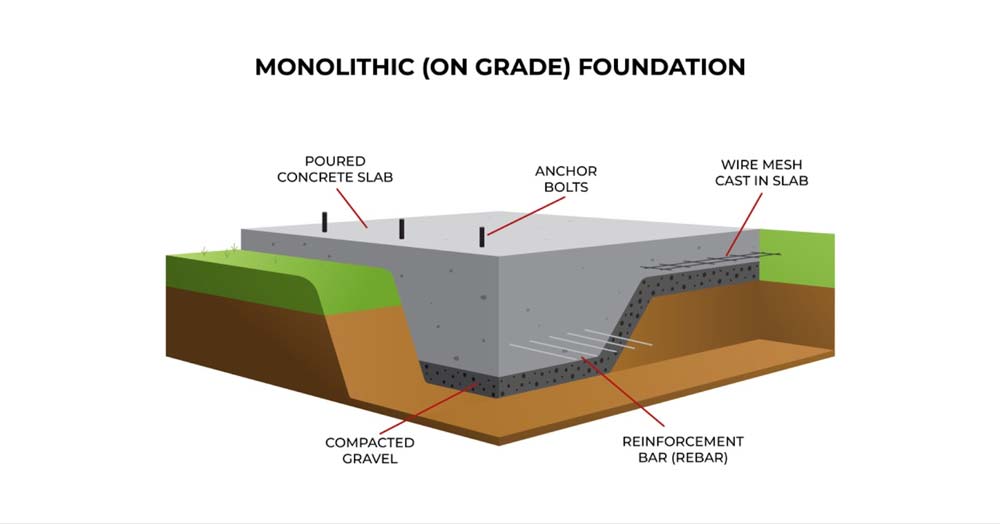
Step Three is the Monolithic Pour and Slope Verification.
We pour the 4,000 PSI commercial concrete, embed the cast-in-place iron truncated domes, and apply a specialized slip-resistant broom finish. Before we leave the site, we document the cured surface with our digital levels, providing you with the exact mathematical proof required to clear your violation with the Dallas Code Compliance department immediately.
Preventing Massive Business Interruption During the Pour

The absolute greatest fear a retail business owner harbors when scheduling concrete work is the prospect of having to shut down their main entrance. You cannot afford to lock your doors for an entire week, turning away hundreds of paying customers simply because the walkway is covered in wet cement. We completely neutralize this operational anxiety through highly strategic project management. We engineer our installations to guarantee continuous business operations.

Phased Pouring for Continuous Business Operations
When replacing a primary commercial entrance, we utilize phased pouring techniques. We physically split the entrance in half with secure barricades, demolishing and pouring the left side of the ramp while directing your customers safely through the right side. Once the first half cures, we swap the barricades and complete the remaining section. Furthermore, we deploy high-early-strength concrete mixes fortified with advanced plasticizers. These specialized commercial mixes drastically accelerate the hydration process, allowing the new concrete to safely support heavy foot traffic in a fraction of the time required by standard cement. Your business remains open, your customers remain safe, and your cash flow remains uninterrupted throughout the entire compliance upgrade.
Retrofitting 1980s Storefronts vs. Modern Corporate Plazas
The architectural landscape of commercial Dallas spans several decades, and accessibility requirements vary widely by era. If we are contracted to retrofit a completely non-compliant 1980s strip center along Greenville Avenue, we are typically dealing with narrow, crumbling sidewalks that were poured long before modern ADA regulations existed. These older structures often feature abrupt, four-inch step-ups directly into the retail doors. Correcting these legacy properties requires aggressive concrete cutting, deep structural doweling to tie the new ramps into the existing aged foundation, and careful maneuvering around mature street trees. Conversely, when we are hired to pour massive, integrated pedestrian plazas for a modern corporate headquarters in Frisco, the engineering focuses on flush transitions. These high-end modern builds require massive, sweeping, barrier-free approaches that integrate seamlessly with the surrounding architecture and landscaping. We utilize expansive, low-slope grading techniques that make the accessibility features virtually invisible, blending the ramps directly into the surrounding aesthetic rather than treating them as an afterthought. We adapt our concrete engineering to match the exact era and style of your commercial asset.
The Egregious Liability of the Illegal Asphalt Ramp Patch
When facing a sudden accessibility complaint, some property managers panic and authorize a terrible, illegal shortcut. The most dangerous “fix” in the commercial paving industry is the asphalt ramp patch. A cheap handyman will arrive with a few bags of cold-patch blacktop and slap a sloppy, uneven wedge of asphalt directly against the vertical face of the city curb, claiming it meets the wheelchair-access requirement. This is an egregious violation of both federal and municipal law. First, cold-patch asphalt is incredibly soft and uneven; it instantly ruts under the weight of a motorized wheelchair, failing the ADA requirement for a firm, stable, and slip-resistant surface. Second, slapping a wedge of asphalt against the street curb completely blocks the municipal gutter flow. During a heavy rainstorm in Dallas, the illegal patch acts as a dam, backing up thousands of gallons of street runoff and flooding the public roadway. Dallas Code Compliance will issue severe, compounding fines for obstructing the storm drainage system. We eliminate this amateur liability. We perform surgical curb cuts, physically removing the vertical concrete barrier and pouring a recessed, monolithic ramp that seamlessly integrates with the street gutter without interrupting the vital flow of municipal stormwater.
The Profound Physical Relief of Barrier-Free Access
Operating a non-compliant commercial property carries a heavy psychological toll that you experience viscerally. It is the sharp spike of anxiety you feel in your chest when you watch a delivery driver struggling dangerously to muscle a heavy hand-truck backward over an excessively steep, warped curb, terrified that the load will tip and crush them. It is the deep, uncomfortable guilt of watching a customer in a wheelchair or a parent with a heavy stroller fight against a crumbling, uneven pathway, risking a catastrophic fall just to enter your establishment. You should not have to hold your breath every time someone navigates your property. Upgrading to a laser-graded, ADA-compliant concrete ramp completely erases that physical dread.
There is a profound, immediate relief in watching a wheelchair user or a delivery cart glide effortlessly and silently up a flawless, mathematically precise 1:12 slope. The heavy iron truncated domes provide a reassuring, solid grip underfoot, and the perfectly flat landing pad offers absolute stability. We replace the constant fear of an impending accident with the quiet, unshakable confidence that your commercial property is inherently safe and welcoming to everyone.

Mastering Dallas Public Works Standard Construction Details
Paving a commercial sidewalk or a wheelchair ramp within the city limits requires absolute technical fluency in municipal engineering documents. You cannot afford a contractor who is guessing at the city’s requirements. We execute every single commercial flatwork project in strict accordance with the City of Dallas Public Works Standard Construction Details.
Navigating Dallas Right-of-Way Compliance
We specifically adhere to the rigorous parameters outlined in File 251D-1 for sidewalks and barrier-free ramps. This local ordinance mandates that all public-facing sidewalks and ramp landings must maintain a maximum cross-slope of exactly 2.0 percent to ensure water sheds off the path without causing a wheelchair to veer dangerously toward the street. Furthermore, if the ramp intersects a public street, we secure the required Right-of-Way permits and deploy the required MUTCD-compliant traffic-control barricades. We expertly manage the complex bureaucratic interface between federal ADA civil rights law and highly specific local Dallas paving ordinances. We ensure the heavy concrete lugs are poured to the correct depth, the expansion joints are placed accurately, and the final inspection is passed on the very first attempt, shielding your business from ongoing municipal scrutiny.

Calculating the Massive Financial ROI of Strict Compliance
When evaluating the cost of commercial concrete repairs, property managers must look beyond the immediate invoice and analyze the massive financial risk of non-compliance. Investing in a properly engineered, mathematically precise ADA ramp requires upfront capital, but it provides a staggering Return on Investment (ROI) when compared to the devastating alternatives. If a plaintiff’s attorney targets your non-compliant property, a standard ADA discrimination lawsuit settlement easily exceeds $50,000 in legal fees alone, not including the medical damages if an actual physical injury occurred. Even worse, after you pay the massive legal settlement, the federal court will still force you to hire a contractor to tear out the old concrete and build the compliant ramp anyway. We protect your corporate balance sheet by offering highly transparent, upfront flat-rate pricing for compliance resolution. We measure the exact square footage of demolition, the required yards of 4,000 PSI concrete, and the cost of the cast-in-place iron tactile domes to provide a firm, unyielding quote. By proactively investing a few thousand dollars in our precision flatwork, you permanently insulate your asset from tens of thousands of dollars in predatory litigation and devastating municipal fines.

Your Certified Dallas Commercial Concrete Partners
An accessibility barrier is an active threat to your business license, your financial security, and your patrons’ safety. When facing the strict mathematical demands of federal ADA laws and local Dallas building codes, you cannot afford to hire general handymen who rely on guesswork and cheap plastic materials. Urban Concrete & Construction stands as the premier technical authority for commercial ramps and code-compliant sidewalks in the Dallas Metroplex. We utilize advanced digital laser verification to guarantee perfect 1:12 slope ratios, we embed heavy-duty iron truncated domes for permanent tactile warning, and we deploy rapid-curing concrete to ensure your business operations remain completely uninterrupted. We understand the aggressive nature of North Texas clay, we master the complexities of the Dallas Public Works manuals, and we respect your need for rapid, discreet construction. Do not let a quarter-inch deviation in your concrete invite a devastating lawsuit. Take immediate control of your property’s liability. Contact our central Dallas dispatch team right now to schedule a comprehensive accessibility audit, and let us engineer the flawless, barrier-free access your commercial facility demands.
Frequently Asked Questions About Commercial ADA Ramps
How much does a commercial ADA concrete ramp cost in Dallas?
The average cost is $3,500 to $8,000 for a standard ADA-compliant commercial concrete ramp. In Dallas, the exact price depends on the linear footage needed to achieve a 1:12 running slope and the extent of heavy demolition. Urban Concrete & Construction provides upfront flat-rate quotes that include laser-guided grading, right-of-way permits, and cast-in-place iron truncated domes.
What is the daily fine for a Chapter 43-63 sidewalk violation in Dallas?
The maximum penalty is up to $2,000 per day for failing to correct a hazardous commercial sidewalk or wheelchair ramp. Dallas Code Compliance inspectors issue these strict liability citations when a property owner ignores uneven flatwork or non-compliant cross slopes. Urban Concrete & Construction rapidly deploys to demolish the hazard and pour a mathematically verified barrier-free approach before municipal liens accumulate against your property.
Does my commercial property insurance cover ADA concrete ramp upgrades?
No, standard commercial general liability insurance does not cover preventive ADA concrete ramp upgrades or structural retrofits. Insurance underwriters classify compliance with the Americans with Disabilities Act as a mandatory operational expense rather than a sudden peril. However, investing in Urban Concrete & Construction’s precision flatwork immediately protects your business from predatory discrimination lawsuits and catastrophic legal settlements.
How long do I have to wait before pedestrians can use a newly poured concrete ramp?
It takes 24 to 48 hours for a newly poured commercial concrete ramp to safely support pedestrian foot traffic and motorized wheelchairs. While the 4,000 PSI concrete matrix takes 28 days to fully cure, we utilize high-early-strength mixes with advanced plasticizers to dramatically accelerate the initial hydration phase. Urban Concrete & Construction utilizes phased pouring techniques to ensure your retail storefront maintains continuous business operations during this brief curing window.
What is the difference between cast-iron truncated domes and glued-on plastic tactile mats?
Cast-iron truncated domes last 30 to 50 years, while glued-on plastic tactile mats typically peel and fail within 12 to 24 months. The intense Dallas summer heat quickly destroys the industrial adhesives used on plastic mats, instantly creating a severe trip hazard at the base of your wheelchair ramp. Urban Concrete & Construction exclusively installs heavy-duty, iron-detectable warning surfaces by embedding them directly into wet concrete for permanent, code-compliant tactile paving.
Are steeper 1:10 ramps ever legal for commercial buildings in Dallas?
Yes, a 1:10 running slope is legally permitted only on historic or pre-1992 buildings where severe space limitations preclude a standard 1:12 slope, and the maximum vertical rise is 6 inches or less. Modern commercial construction universally demands the standard 8.33 percent maximum incline. Urban Concrete & Construction coordinates directly with Dallas municipal inspectors to verify these rare topographic exceptions before pouring any non-standard architectural concrete.
Do I need a Right-of-Way permit to replace a commercial sidewalk in Dallas?
Yes, you must obtain a Right-of-Way (ROW) permit from the City of Dallas Public Works Department to alter any sidewalk or curb ramp intersecting a municipal street. Executing heavy demolition on public easements without approved traffic control plans and barricades will result in immediate stop-work orders. Urban Concrete & Construction handles this complex bureaucracy internally, ensuring your new barrier-free access strictly complies with File 251D-1 paving standards.
What happens if a Dallas utility box blocks the path of a new commercial wheelchair ramp?
We must redesign the ramp trajectory or construct a widened level landing pad to bypass the municipal utility box while maintaining a compliant 36-inch clear width. You cannot legally alter or pave over Dallas Water Utilities meters or electrical vaults located in the public right-of-way. Urban Concrete & Construction engineers custom switchback ramps and use digital smart levels to navigate around existing civic infrastructure without exceeding the 1:48 cross-slope maximum.